
One of the most common questions I am asked when supporting disciplinary, grievance, capability, and workplace investigations and procedures with HR advice is:
“How can you be impartial, fair and independent when the employer is paying you?”
It’s a fair question.
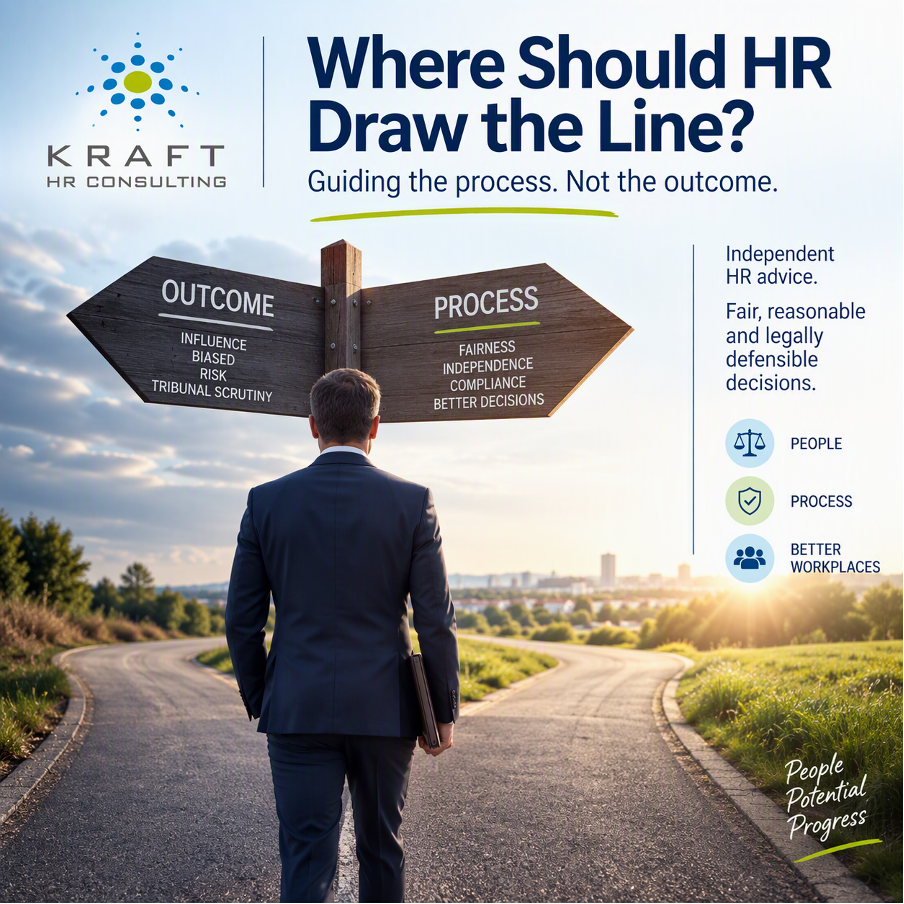
As an external HR consultant, I am engaged and paid by the employer. However, my role is not to achieve a particular outcome. My role is to ensure that disciplinary and grievance procedures are conducted fairly, reasonably, consistently, and in accordance with employment law and ACAS guidance.
The employer is paying for professional HR advice that helps ensure decisions can withstand scrutiny from an Employment Tribunal, Employment Judge, ACAS Conciliation Officer, trade union representative, regulator, or other independent third parties.
Good HR advice protects both employers and employees. It reduces legal risk, improves procedural fairness, and helps organisations make sound decisions based on evidence rather than assumptions.
The distinction between legitimate HR support and improper HR influence is crucial to understand. Read on for an exploration of what HR impartiality looks like and how employment tribunal cases have informed HR best practice.
What does HR impartiality actually mean?
A common misconception is that impartiality means having no opinion.
In reality, impartial HR practice means:
- Approaching every case with an open mind.
- Following the evidence wherever it leads.
- Ensuring a fair workplace investigation.
- Advising decision-makers honestly about legal and procedural risks.
- Treating all parties consistently and fairly.
- Supporting compliance with employment law and ACAS principles.
HR is not there to secure a dismissal and nor is HR there to secure an acquittal. The role of HR is to help employers reach decisions that are fair, reasonable, evidence-based, and legally defensible.
Problems arise when HR moves beyond procedural guidance and begins influencing findings of fact, credibility assessments, or disciplinary outcomes.
Employment tribunals have repeatedly examined where this boundary lies.
Ramphal v Department for Transport: When HR influence goes too far
The leading employment law authority on HR impartiality remains Ramphal v Department for Transport (read the summary and judgement here: gov.uk/employment-appeal-tribunal-decisions-0352-14-da).
In this case, an investigating manager initially produced a report that was relatively favourable to the employee and recommended a final written warning. Following extensive communications with HR, the report changed significantly. Positive findings were removed, criticism increased, and the recommended sanction became summary dismissal for gross misconduct.
The Employment Appeal Tribunal confirmed that HR professionals may provide advice on:
- Procedure
- Employment law
- Consistency
- Organisational policy
- Documentation
However, HR should not influence:
- Findings of fact
- Witness credibility assessments
- Judgements on culpability
- Decisions regarding sanction
The judgment included a key principle that continues to influence workplace investigations today:
“An employee facing disciplinary proceedings is entitled to expect that decisions about culpability will be taken by the appointed decision-maker and not by others behind the scenes.”
For HR practitioners, the lesson is simple: HR can advise, challenge, guide, and question and HR must not become the decision-maker by proxy.

Workplace investigations must be independent and fair
The importance of independence was also highlighted in Williams v Meddygfa Rhydbach Surgery (read the case summary and judgement here: gov.uk/employment-tribunal-decisions/-1600487-2016).
In that case, the tribunal found that individuals appointed to investigate grievances had been unduly influenced by senior figures within the organisation. The tribunal ultimately concluded that the claimant had been constructively unfairly dismissed.
The case demonstrates an important principle:
Justice must not only be done, it must be seen to be done.
When employees believe an investigation, disciplinary hearing, or grievance process lacks independence, confidence in the process can quickly disappear.
This applies equally to:
- Internal HR teams
- External HR consultants
- Investigating officers
- Appeal managers
- Senior decision-makers
Read our practical guide to carrying out fair and impartial workplace investigations for an ACAS-compliant process to within any workplace in the UK and Ireland.
So can HR draft disciplinary outcome letters?
Yes. Recent decisions have clarified that HR involvement is not inherently problematic.
In Shing v University of the Arts London, the Employment Appeal Tribunal reinforced that the decision in Ramphal does not require HR to remain entirely hands-off (read the case summary and judgement here: gov.uk/employment-tribunal-decisions/-2202043-slash-2021).
The key question is whether HR exerted undue influence over the decision-maker. The Employment Appeal Tribunal recognised that HR may legitimately advise on:
- Disciplinary procedures
- Employment law requirements
- Organisational policies
- Consistency of treatment
- Distinguishing misconduct from gross misconduct
- Drafting outcome letters and documentation
Importantly, there is nothing inherently wrong with HR drafting disciplinary or grievance outcome letters provided the final content reflects the independent conclusions of the appointed decision-maker.
What’s clear is that the issue is not drafting, it’s changing the decision.
Why independent HR advice benefits employers and employees
As an external HR consultant, I occasionally encounter scepticism from employees who assume that because HR is instructed by the employer, the advice will automatically favour management.
In practice, experienced HR professionals frequently advise employers against the course of action they initially wish to take.
Examples include:
- Recommending that disciplinary allegations should not proceed due to insufficient evidence
- Advising that a workplace investigation should be reopened
- Highlighting procedural flaws that require correction
- Recommending mediation instead of formal action
- Advising that a proposed sanction falls outside the range of reasonable responses
- Explaining why a dismissal would carry significant legal risk
Employers rarely engage external HR consultants simply to validate existing decisions. They engage them to provide objective advice, manage risk, improve decision-making, and ensure fair processes. In many respects, independent HR advice protects everyone involved.
Best practice: How HR professionals demonstrate impartiality
1. Separate advice from decision-making
HR should advise and managers should decide. Decision-makers must retain ownership of findings, conclusions, and outcomes.
2. Test all evidence fairly
Evidence supporting both the employer and employee should be scrutinised equally. Selective challenge undermines confidence in the process.
3. Document the reasoning
Employment Tribunals frequently examine not only the final decision but how that decision was reached. Clear records help demonstrate procedural fairness.
4. Follow the ACAS Code of Practice
The ACAS Code of Practice remains one of the primary benchmarks used when assessing disciplinary and grievance procedures. Employers should ensure investigations, hearings, and appeals are conducted reasonably and consistently.
5. Maintain transparency
Transparency promotes trust and reduces allegations of bias. Employees should understand:
- Who is investigating
- Who is advising
- Who is hearing the case
- Who is making the decision
6. Protect professional integrity
Whether internal or external, HR professionals must be prepared to provide objective advice even when it is unpopular. Professional credibility is one of HR’s most valuable assets.
Frequently asked questions about HR impartiality
Is HR supposed to be impartial?
Yes. HR should provide objective advice based on evidence, policy, employment law, and procedural fairness rather than attempting to achieve a predetermined outcome.
Can HR make disciplinary decisions?
Generally, managers and appointed decision-makers should make disciplinary decisions. HR’s role is typically advisory rather than decision-making.
Can HR influence disciplinary outcomes?
HR can advise on process, risk, consistency, and policy. However, employment tribunals have indicated that HR should not improperly influence findings of fact or sanctions.
Can an external HR consultant be independent?
Yes. An external HR consultant can provide independent and objective HR advice while being instructed and paid by the employer. Professional credibility depends on providing unbiased recommendations.
What is the key lesson from Ramphal v Department for Transport?
The case confirms that HR can advise on procedure and employment law but should not determine culpability or influence disciplinary outcomes.
Final thoughts
The debate is not whether HR should be involved in disciplinary, grievance, capability, and workplace investigation processes. Modern organisations rely on HR expertise to ensure consistency, compliance, and fairness.
The real question is whether HR is helping decision-makers make informed decisions or whether HR has become the decision-maker itself. Employment tribunals have consistently shown that they are comfortable with HR professionals advising on employment law, procedure, policy, consistency, and drafting. What they will not tolerate is HR influencing findings of fact or directing outcomes behind the scenes.
The strongest HR practitioners are not advocates for either side, but are guardians of fairness, process, and sound decision-making. From my personal experience of thousands of cases, I can confidently say that when the process is fair, employers and employees both benefit.
Contact me or our sister company Kraft HR Investigations for support with any part of an investigation or decision-making process, or read our practical guide.


